“During times of universal deceit, telling the truth becomes a revolutionary act.” George Orwell


Saturday, June 18, 2016

Overcorrections from 1 Corinthians 12:22-23

The phrases "seems weaker" and "we think less honorable" are both social determinations. Just to say "seems" implies a not entirely sound determination. Depending upon the task at hand, how I have been socialized, and my experience will determine how I perceive someone. However, there may be criteria for making this determination which are less than obvious or even unknown, needing to be discovered from a Biblical perspective, criteria may need to be taken by faith.
I have quoted this excerpt from The Letters of JRR Tolkien before, but it bears repeating (Carpenter & Tolkien, 1981, #246, p 326). He wrote...
Frodo indeed failed as a hero, as conceived by simple minds: he did not endure to the end; he gave in, ratted. I do not say simple minds with contempt; they often see with clarity the simple truth and the absolute ideal to which effort must be directed, even if it is unattainable, their weakness, however is two fold.
They do not perceive the complexity of any given situation in Time, in which an absolute ideal is enmeshed. They tend to forget that strange element in the world that we call Pity or Mercy, which is also an absolute requirement in moral judgement (since it is present in the Divine nature). In its highest exercise, it belongs to God.
Complexity may be hidden in a variety of ways. However, complexity hidden is still present. There is hidden complexity in people who seem to be weaker being indispensable. Apparently if they are indispensable, they are not weaker on every level, though they may appear so on some or many. In one or more ways, they can't be done without. Apparently, however, people do not perceive this.
Weakness and dishonor may be thought to be related, and may be, depending upon the culture. When rugged individualism was the value in America (seems to be less so today), weakness would be equated with dishonor. So as can be seen, dishonor may be largely socially determined. In another culture, where community is valued, an over emphasis on individualism might be considered worthy of less honor.
Personal characteristics generally speaking, whether the result of choices that people make or personal circumstances out of one's control can lead to dishonor. For our purposes, characteristic which may accompany impairment can cause society to think one less honorable.
However, at the same time, "seems" and "we think" although entirely subjective, may still lead to actions/behaviors based on these subjective determinations. You needn't be weaker for me to treat you as such and my treatment may actually contribute to you not only seeming to be weaker but you actually becoming weaker. And my treatment of you may actually contribute to you not only being though of as less honorable but actually becoming less honorable.
For example, I think an adult with intellectual disabilities is a child so I treat him in that manner, as weaker in the same ways a child is weaker than an adult. That person then perhaps embodies that perception to the point that they become weaker, like a child, as a result of that treatment. Treating someone who is an adult as a child causes them to experience disrespect, dishonor in the thinking of those who are observing, leading to a similar dishonoring (at best) in the observer's interactions.
I spoke at a conference in the US recently, and many of those in attendance could not understand this. The idea of treating someone in an age appropriate fashion was alien to them, and they would not accept the FACT that they were contributing to the devaluation of another person.
To correct by saying the seemingly weaker one is indispensable, is actually a significant overcorrection. He doesn't say that the seeming weaker are "pretty strong" or "actually can do some things" he goes to the absolute other end of the strength/weakness continuum saying they are indispensable.
The same thinking applies to those thought less honorable. We don't show them some patience or a little, rather we give them special honor. Perhaps honor above and beyond what we would typically show any person. Once again this is an overcorrection.
Why these overcorrections? Perhaps this is an attempt to bring things into balance or perhaps this is to make a point. Perhaps to support the statement that begins "on the contrary." The result of this perspective change should be a significant change in behavior. It demands we treat others with special honor now, which is a change in ourselves but also a change in perspective towards others. If ind out I desperately need others when before I didn't realize that I desperately needed them. The implication in both of these statements is that I have to be told about this relationship because my behavior indicates that I don't understand it. What would be evidence that I do understand? A significant change in my behavior. If someone would look at me interacting with someone in a way that reflects these prescriptions, it would cause them to wonder what it is that I see to cause me to act so differently. It may be that I do see something different which guides my behavior. Or it could be that I change my behavior as a result of what I am told and either actually do see or by faith I hope to see the indispensable nature and hope to see the result of treating someone thought less honorable with special honor.
It is as Amy Carmichael said in Things as they are, "...we believe to see, and believing even now we see..."

McNair

Thursday, June 16, 2016

Amy Carmichael and cultural change

Amy Carmichael was the famous Irish missionary to India. In her book, "Things as they are: Mission work in Southern India" (1905) she quotes Elizabeth Barrett Browning's poem Aurora Leigh. The poem states, "It takes the Ideal to blow a hair's-breadth off the Dust of the Actual." Amy's response is, "It takes more. It takes God. It takes God to do anything anywhere" (p. 60). Later in the book she expands on this point. She was writing about mission work with Hindus. Think about this in context of our work with persons with disabilities within the church. She writes,
This custom as it stands is formidable enough. Many a man Indian and foreign has fought it and failed. It is a huge and most rigorous system of tyrannical oppression, a very pyramid to look at, old, immovable. But there is somthing greater behind it. It is only the effect of a Cause-the Dust of the Actual.
What can alter the custom? Strong writing or speaking, agitations, Acts of Parliament? All these surely have their part. They raise the questions, stir the Dust - but blow it off? Oh no! Nothing can touch the conscience of the people, and utterly reverse their view of things, and radically alter them, but God.
Yes, it is true, we may make the mose of what had been done by Government, by missionaries and reformers, but there are times in the heart histories of all who look far enough down to see what goes on under the surface of things, when the Sorrow takes shape in the Prophet's cry "we have not wrought any deliverance in the earth."
It is true. We have not. We cannot even estimate the real weight of the lightest speck of the Dust that has settled on the life of this people. But we believe to see, and believing even now we see; and when we see anything, be it ever so little, when the Breath breathes and even"a hair's-breadth" of that Dust is blown away, then, with an intensity I cannot describe, we feel the presence of the Lord our God among us, and we look up in the silence of joy and expectation for the coming of the Day when all rule, and all authority and power, yea, the power of the very Actual itself, shall be put down, that God may be all in all." (p. 68-69)

As I read this, I was touched by three quotes in particular. She says, "Nothing can touch the conscience of people and utterly reverse their view of things, and radically alter them but God."
Later she says,
"But we believe to see, and believing even now, we see..."
Finally she states,
"It takes more. It takes God. It takes God to do anything anywhere."

I was honored to be able to deliver a sermon last week at The Welcome, the church that Amy Carmichael started over 100 years ago. As I prepared for that talk, the above words really impressed on me the depths of the change we are hoping to see happen in the church. It is a dramatic cultural change. Something insidious underlies the "Dust of the Actual." We need to utterly reverse people's views of things. But we can't do that, no one can but God. At the same time, however, through faith, we believe to see. We can to some extant envision what that cultural change would look like. Yes we can work and yes we should work. But for the dramatic wholesale change culturally that needs to happen within the church, change of something tyrannical, and something old and immovable like a pyramid, our only hope is God. It is very unlikely people will embrace changes in the traditions of man in order to embrace the commands of God (Mark 7:8 & 13).

Let's begin to pray in that direction. We can do what we can but once again,

"Nothing can touch the conscience of the people, and utterly reverse their view of things, and radically alter them, but God."

McNair

Friday, May 20, 2016

Seeing disability as the change in me

In other places on this blog, I have discussed the question, "What is disability?" I often will settle on saying that it is a combination of the medical model, characteristics of individuals and the social model characteristics of environments. Therefore, when I endeavor to address disability with interventions, I will try to help people with impairments to improve their skills, abilities, etc. and I will attempt to change environments such that they are not discriminatory against people who have the characteristic called impairment.
As I have thought through these effort to address disability, it occurs to me, particularly in the context of ministry, that when my work to address disability changes me, I have experienced success in changing the impact of disability. We often look for changes in individuals (they understand something, or have improved in some way for example as the result of special education) or changes in the larger social environment (such that it is less discriminatory or more willing to embrace integration, etc.). However, an equally relevant evidence of successfully addressing "disability" is the change that is seen in the change agent himself.
If I am more friendly, or tolerant or loving as a result of my efforts, I have experienced success in addressing disability in an individual or group.
Clearly, if our interventions only result in changes in the individual with the impairment, we are not fully addressing disability as defined above. Equally true is that if we only intervene to change the environment and do not work to assist someone with impairments to maximize their potential, we are also not fully addressing disability. However, it encouraging to note that the changes I see in myself are at the very least a small measure of my success in addressing disability.


McNair

Tuesday, April 19, 2016

Why secular human services needs the church.

When disability experts try to explain what disability is, they may use two models of disability: the medical model and the social model.


The medical model tends to see disability as a characteristic of an individual. So those in special education, or rehabilitation or other fields, including medicine, see a characteristic of an individual and attempt to improve the person's life who has that characteristic. In special education, for example, innovative methods for teaching reading have been developed to maximize a student's reading ability who might have difficulty learning to read. There is nothing wrong with these kinds of approaches. The problem sometimes comes when disability is seen as exclusively a characteristic of individuals.


The social model basically says that disability is discrimination. That is, I have a characteristic called impairment (whether physical, intellectual, etc.) and because of that characteristic, I am treated with discrimination by the social environment.


In thinking about how to address disability via interventions of one sort or another, it seems that human services (education, social work, rehabilitation, etc.) tend to focus almost exclusively on medical model strategies. They work to improve my skills, or my health or other things related to me personally. It is rare if at all that there are social model interventions undertaken. Let's think that through for a minute.


Imagine we have two individuals. One is the a person who is living in society, but they have no religious interest or are not participating in any kind of religious group. The other person is someone who has a religious interest and does participate in a Christian church of some flavor. How would one attempt to develop social model interventions aimed at diminishing discrimination in each person's social group?


For the individual who does not participate in a religious group, this becomes somewhat difficult. First of all, in which social settings would they find some form of integration? These are limited at best. If I were to attempt some form of intervention to reduce discrimination, it would have to be with the larger community, or city or even state or nation. It is no wonder that these types of interventions are rarely undertaken by human service providers. They are hugely daunting. It may actually be that human services are so medical model based that there is little effort to first of all even work toward community integration or understand what it is (visit this article for more on this), and second address social model issues. So there is probably less awareness over discrimination related to clients being in the community.


For the individual who does participate in a religious group, a Christian church, the foci for intervention is much more easily determined. If the church is comprised of 1000 members, for example, I can work within that social setting to mitigate discrimination which might be occurring. I can talk with leaders of the group, trying to help them to understand the discrimination that persons with impairments experience, give them strategies to reduce that on just a logical basis, or on the basis of the scriptures they state as underlying their religious practices. In other words, there are many options I might follow to work to reduce discrimination. I have worked doing these types of interventions with some degree of success.


I think the take home lesson of this is first that social model interventions are not occurring because human service providers envision a life for persons with disabilities that apparently does not include community integration based only on observable interventions they engage in. Second, religious/church involvement puts the possibility of social model interventions on the table in an easily employed manner.


Those in human services should seek the opportunity for church involvement for those they serve for a variety of reasons. But one of the most important is the ability to develop and implement social model interventions which would lead to community integration and attenuated discrimination toward those with impairments.


McNair

Tuesday, March 29, 2016

Things I learned but was never taught - Presence

I have been thinking a lot about presence. How the presence of persons with particularly severe disabilities changes those around them. Clearly social environments are not the same with or without a person with a severe disability in that environment. I suspect we choose to not have the environment that develops as a result of having the person with the severe disability in it based on the preponderance of environments that I have found myself in. But I also find that when I am in those environments with those people I learn things. It is not like coming to one of the classes that I teach where I discuss lessons from a particular reading, or try to teach my graduate students something. The learning comes from people who actually evidence little interest or understanding of the fact that they have the ability to be teachers to those around them. I have learned so much in those types of settings. But such learning is not at all unique to me.


It was Henri Nouwen who described Adam, a man with severe intellectual disabilities for whom he acted as a caretaker as "my friend, my teacher, my spiritual director, my counselor, my minister." You might read those words and dismiss them thinking, "What a nice thing to say about someone" particularly someone with a disability who has been devalued by most of society. "He is trying to bring dignity to someone who doesn't have any" you might think. But it is not a sweet thing to say about someone, it is the truth. If one submits oneself to such relationships and one is paying attention, there are so many things that are learned. As in the title of this posting, they are things learned which were never taught.


We learn things about society, we learn things about ourselves. We also learn things about the person with the disability if we give sufficient time to learn them. Once again it is about presence. Presence changes things, it reveals things. I have mentioned elsewhere in this blog about how the presence of a man beaten and left for dead revealed the character of those around him in the story of the Good Samaritan. It is that kind of learning.
"What will I be willing to do in such a situation?" I learn about myself.
"How will the enviornment change when people who have not been integrated experience full integration?" I learn about the social enviornment, be it the church or other social settings.
"Do I love my neighbor?" A challenging neighbor will reveal that to me.
"Do we as a church love our neighbor?" A challenging neighbor also reveals the heart of those in the larger environment.


Once again there is no effort typically on the part of the person with the disability to teach anybody anything. But the lesson is there and the possibility of learning is there.


Will we allow, no, will we facilitate the potential for this type of learning to occur?
McNair

Monday, March 07, 2016

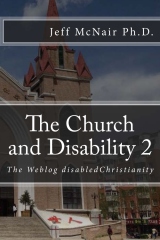
The Church and Disability 2: The Weblog disabledChristianity

The Church and Disability 2 is the latest collection of blog postings from the disabledChristianity weblog. It is gleanings from the past 5 years in a single volume. It includes many of the ideas that readers have told me that they have been stimulated by and have enjoyed interacting with over the years. It is available by clicking on the cover image or from Amazon. It will shortly also be available in a Kindle format.

New Book from Jeff McNair

Regards,
Jeff McNair

Sunday, March 06, 2016

Neglecting a human being right in front of us

I will at times read books about the church or Christian behavior. I am currently reading a book about the church. It always strikes me how writers can put forward convicting principles but seem to totally miss the connection to people whom society has devalued due to their impairment or disability. They will, for example, be very convicting about those who live in poverty (as in the quote below) but seem to be totally unaware and complicit in the treatment or exclusion of those with disabilities, not seeing the connection with that group of devalued people. Here for example is a quote from a book I am reading at the moment.


Moreover, the rich man in Luke 16 is damned because he ignores poor Lazarus at his gate. His sin is a sin of omission. But this omission is more than a general failure to "do more" or "do enough." His extravagant wealth makes him blind to the needs right in front of him. As John Schneider puts it:


The strong obligation-generating power is in the immediate moral proximity of someone in dire need. What makes the behavior of the rich people in these parables so very hideous and damnable is not that they had wealth, or even that they enjoyed it. It is that they did so, like the rich in Amos, in spiritual obliviousness to grievous human suffering that was as near to them, in the moral sense, as it could be. It was not merely that they neglected "the poor," but that they neglected a human being in need directly in front of them.


Lazarus, not the poor in abstract, was the rich man's test, and the rich man failed.
(John. R Schneider, the Good of Affluence: Seeking God in a Culture of Wealth (Grand Rapids: Eerdmans, 2002), 178). (Above quote from, DeYoung, K. & Gilbert, G. What is the missio of the church? (Wheaton, Il: Crossway, 2011).


There is no real mention of persons with disabilities, at least thus far, in describing the mission of the church. They talk about people groups, and the notion of "social justice" in a very general sense. They also make comments or glean and share quotes such as the above. Look at the last sentence of the second paragraph above. "It is that they did so, like the rich in Amos, in spiritual obliviousness to grievous human suffering that was as near to them, in the moral sense, as it could be. It was not merely that they neglected "the poor," but that they neglected a human being in need directly in front of them." That is the experience of many people who have experienced social isolation, and the practice of many churches and members of the Christian community towards persons with disabilities. Human beings in need, directly in front of us, are neglected. They are too much trouble, or they are off putting because of their social skills, or whatever other reason. Additionally, we feel no need to change our behaviors.
Oh that God would open all of our minds such that we would love our neighbors. Oh that we would see those people directly in front of us. They are in the community, everywhere. What if we made the effort to put them in front of us of our Christian community. Our leaders have given us an excuse for not doing anything by not putting people in need in front of us. I guess it is up to us to seek those people out, bring them into our social circles, and further remove the excuses which have been plaguing us.


McNair

Wednesday, February 10, 2016

"...a splinter in your mind"

I love the movie The Matrix. I have quoted it elsewhere in this blog. When Neo "awakens" from being inside the matrix he has the following conversation with Morpheus.


Morpheus : Your muscles have atrophied, we're rebuilding them.
Neo : Why do my eyes hurt?
Neo blinks
Morpheus : You've never used them before.

The point of the story is that virtually everyone in the world is not living in reality. They are living in a world that has been created for them, in this case by computers who are controlling them, that blinds them to reality. Morpheus awakens Neo to this reality when he disconnects him from the matrix such that he now understands reality and now is living in reality. Upon awakening to the truth, Neo is confused. He doesn't have muscle control and when he looks around, his eyes hurt. As Morpheus says, they hurt because, "You've never used them before."

I sometimes feel like I live in that same kind of unreality. In many ways I have been blinded to reality and in a variety of venues, even Christian venues, I have been taught unreality. When I try to love my neighbor, it "hurts" in part because I for that moment traverse the world of unreality into reality and whatever part of me gets used that hasn't been used in the past hurts me.

Earlier in the conversation between Morpheus and Neo, when Neo is presented with the pills there is this dialogue.

Morpheus sits down in the armchair opposite from Neo
Morpheus : Do you believe in fate, Neo?
Neo : No.
Morpheus : Why?
Neo : Because I don't like the idea that I'm not in control of my own life.
Morpheus : I know..._exactly_ what you mean. Let me tell you why you're here. You're here because you know something. What you know, you can't explain. But you feel it. You've felt it your entire life. That there's something _wrong_ with the world. You don't know what it is, but it's there...like a splinter in you're mind, driving you mad. It is this feeling that has brought you to me. Do you _know_ what I'm talking about?

Of course in the movie, Morpheus is talking about the matrix, the unreality that people live in of which they are totally unaware. But there is an unreality of which we may be unaware in our lives as well. I feel the unreality in the church. Perhaps you can resonate with the lines above. 
"You are here because you know something." Do you ever wonder why you know something or see something that others do not?
"What you know you can't explain." I know that something is not right, it needs to be changed.
"But you feel it. You've felt in your entire life." The feeling is consuming and overwhelming. When you share it with others, you feel like and sound like a broken record. They listen kindly, but perhaps don't fee the urgency that you feel, have felt, for as long as you can remember.
"That there's something wrong with the world." That there is something wrong with the church. You know it, get glimpses of it, are desperately trying to put your finger on it.
"You don't know what it is, but it's there...like a splinter in your mind, driving you mad." You are trying to understand why what is wrong is wrong. You feel like it might be about what the vision is. Like a splinter that you are trying to get out of your finger, you are desperate to get this splinter out of your mind. It is like if you could describe both what is wrong and what should be, you would finally have some peace as the splinter would be gone. Once you got it out, you could look at it, and with some degree of relief, you could point to the splinter and feel like "That is what I have been trying to get out of me!"
"It is that feeling that has brought you to me." Well not to me per se, but to this kind of information. Perhaps you come to a blog like this hoping to get what you know affirmed. To know you are not alone in your thinking. When Neo meets Morpheus, all that he suspected is affirmed.
"Do you know what I'm talking about?" Of course you do, reader. You are struggling with the same things that I am.

If our eyes hurt, that is a good thing as we are finally using them. If you have the splinter in your mind, that is a good thing as God is perhaps trying to get you to do something, to understand something. If you are being hurt as you try to understand what God has put on your heart, that is also a good thing.People around you likely will not understand you. I have felt this. I try to humble myself to be sure that it is the message that they are rejecting and not the attitude of the messenger. But clearly, even as we grow in the development of ministry to and with persons with disabilities we will continue to face opposition as we push the envelope (1 Peter 2:20-21 says, "...But if you suffer for doing good and you endure it, this is commendable before god. To this you were called, because Christ suffered for you, leaving you and example, that you should follow in his steps).

But whatever you do, do not lose your vision but ask God to clarify your vision. That has been my prayer in recent months, that God would give me a clear vision for the church as it regards loving our neighbor. In particular, loving people who have had devaluation done to them.

McNair

Thursday, February 04, 2016

"Being seen"

I had the privilege of hearing Katherine and Jay Wolf on Tuesday. They are an amazing couple with a website, and a book http://www.hopeheals.com/#welcome . I would recommend you go there and read the book.


Their presentation about their life experience was amazing, filled with trials subdued by hope. As they have come to understand disability, they made a point about a realization that had come to them. Basically it is that people with disabilities need to "be seen." It is a very basic starting point, but it is easy to understand that it is the beginning of everything. If I see you, you are in my presence and I am no longer avoiding you, at least on some level. If I see you, I begin to enter into your experience, understand a bit about what your life is like. Particularly in the case of individuals with disabilities, I am no longer sheltered from you. I can no longer say, "I didn't know" when someone describes your life experience. Being seen has the potential to be the beginning of manythings.


If people with a particular characteristic are not being seen, that leads to other, potentially negative outcomes. I remember the joke, "What the eye doesn't see, the cook gets away with!" That is, who knows what goes on in a kitchen when no one is watching. Well, what the eye doesn't see, human services gets away with. What the eye doesn't see, group homes get away with. We are often aghast at what people will record on video cameras. But the take home from that is not just that someone was caught doing something, but that the kinds of things that are not seen have been going on all of the time because people are not seen. Don't hear me wrong. I am not advocating increased video surveillance or the use of technology to in some way moniter people. Quite the opposite.


What I would advocate is that you see people with disabilities in your life and advocate that others see them as well. You have the ability to facilitate that by what you do. If I take someone out for lunch, I facilitate them being seen in the community. This is not always easy, though, as much of human services are a barrier to the friendships between people that would allow this to occur. But it is not just human services.


How well is your church doing in ensuring people with disabilities are being seen in a variety of Christian community contexts? Sometimes ministries can be so segregated, it is almost as if those in them are spirited in and out, with no opportunity for interactions with others in the environment. I don't think this is right. I am also not saying that people with disabilities should be put on display somehow. Rather, if they, like everyone else, are simply in the enviornment, singing songs, drinking coffee, listening to teaching, they become like everyone else. I guess "being seen" is a simple test for a level of being integrated.


Are people with disabilities being seen at your church? It is a simple test for integration. If people are being seen, that is a good starting point for many good things that could grow out of that.

McNair

Sunday, December 27, 2015

Ministry shapes the church

How will our involvement in ministry shape the church? It definitely shapes us as individuals. Each of us knows people who are are involved in foreign missions in a variety of ways and that shapes everything down to their dress reflecting their nation of interest. People who are involved with poor and homeless individuals will also take on a particular persona. Some churches who have made that segment of society a priority also change in the way they appear. I know of a church in Riverside California that is very intentional in serving persons who are homeless. They have a daily free lunch program. That in itself shapes the types of people who will be in the neighborhood every day at noon. Other examples might be provided. But you can look at a church and to some degree see who they are in terms of their priorities for ministry. Even the location, whether centrally located or remote communicates something to the community. In our time of ACCESS (in California at least where someone with a disability can call to receive a ride to where ever they want to go) location is perhaps less critical, but there are still those who will struggle to access even slightly more remote places. This is also true because of how people will refuse to pick up others and take them to church.


Clearly there are some communities who are more "impacted" (I actually hate that word because it implies something being forced upon someone rather than them choosing to do something) because of their location. But there are people with some characteristics who are present in every community, like those with disabilities. They are also people who when present will cause the church and its members to develop in a certain way. Some pastors will say that their church is not "impacted" by people with disabilities. It is almost as if they say that with relief as if they were "impacted" they would have to change to become something different that reflects how that ministry will shape them. But if a church leader tells me that they are not "impacted" by disability that doesn't tell me that their are no people with that characteristic in the community. It tells me that there is not any interest in that church in serving people with that characteristic in that community. It tells me that there is not any interest in changing what that will ministry will shape you into if you served people with that characteristic. Do you catch how sad that is? It is literally the desire to skirt the responsibility for first of all loving a whole class of people who may be hurting because of their life experience. And second being unwilling to embrace the change that that form of ministry will bring.


AND...people with the characteristic "disability" are everywhere. So we are too often unwilling to change to become a ministry shaped church that reaches out to the nearly 20% of the population who have a disability and the much higher group that are affected by disability. Can you see how the changes forged in our churches by ministry to persons with disabilities would facilitate ministry orientated churches touching on a major concern of a large portion of the population, anywhere in the world? There is significant potential for a revival within the church if we would just embrace the changes that would come from being "impacted" by those in need of inclusive support. I believe that form of ministry would shape the church toward reflecting God's idea of what it should be.


McNair

Tuesday, December 15, 2015

Milky Ministry

Dear brothers and sisters, when I was with you I couldn't talk to you as I would to spiritual people. I had to talk as though you belonged to this world or as though you were infants in the Christian life. I had to feed you with milk, not with solid food, because you weren't ready for anything stronger. And you still aren't ready, for you are still controlled by your sinful nature. (1 Cornithians 3:1-3, Life Application Study Bible).


I had lunch this past week with a friend, MD Sias. We always have great conversations! He is a man whose heart is for God. In the midst of our conversations about disability ministry he said something to the effect that we are not really prepared to do "solid food" ministry. I immediately got his point and recognized that in many ways we are still at the stage of what might be called milky ministry. So what do I mean by that?


Too often when I am interacting with people about churches including persons with disabilities, the conversation devolves down to a basic misunderstanding of our requirement to love our  neighbor. Now clearly that is not an easy thing to do, however, it is at the same time something that we know that we should obviously be doing. So if you are told that people with disabilities should be a focus of ministry, be included in the church, have their gifting valued, but you respond by saying things like, "they are not a priority for ministry" or "we are not impacted by people with disabilities" or one of myriad other responses given as a reason to not love your neighbor, one must speak to you as one who "belonged to this world or as though you were infants in the Christian life." We must take out the carton and fill the glass with milk.


But this also applies to some ministries. There are ministries that are entirely separate, entirely segregated such that there is little to no impact on the congregation. These are "milky ministries" as far as the church goes. You see I cannot expect the infants that attend to be willing to be changed, be challenged to love neighbors who are different from those who they typically interact with. I cannot expect them to think about providing special honor to others because they think they truly are less honorable (1 Corinthians 12:23). To expect that would be to expect them to eat solid food, something "stronger." Unfortunately these "infants" can be anyone from rank and file members up to the leaders of the church. Why are they not ready for solid food? Paul answers that question. "...for you are still controlled by your sinful nature."


To not love your neighbor is to still be controlled by your sinful nature. Now trust me, I do not love my neighbor as I should. But I know that I should, and I am trying to get better and by God's grace I will! I want to embrace the change that solid food would bring to me. I get visions of what I might be able to become if I could nibble and bite on solid food. I get visions of what the church could be if it would increasingly move toward a diet of solid food as evidenced in ministry related to persons with disabilities that would cause real change.


It is funny that when you get a taste of solid food ministry, you aren't as impressed with milky ministry. You are glad that folks are drinking milk rather than nothing, but you want them to experience the change that being filled with solid food brings.


McNair

Tuesday, November 10, 2015

"Who do you say that I am?"


  Some friends got together as they often did just for a cup of coffee and some conversation. It was clear that one of the group was having a tough day. He hardly raised his eyes, looking at his coffee as it swirled in his cup. He friends noticed his atypical quietness. 

   "Something bothering you?" one of them asked.

   "I am not having a good day" he replied. "I don't like the way people treat me sometimes. I don't understand them."

   The friends looked at him with concern. Sure he was someone with an intellectual disability, but he always seemed friendly, happy, ebullient.

   "I don't get these people. Who do they think I am?" he asked in a moment of clarity.

   "Some people think you are a child. That's why they teach you with flannel graphs and puppets." one friend responded.

   "Some people think you are just not a nice person. That you or your family have done something bad, so you are the way you are." said another.

   "I think some people think you are different from them. That is why they put you away from them with people they think are different because of their impairment, their disability. They think they are doing you a favor by separating you and treating you differently."

   "Some people think you have nothing to give. That's why they don't let you be with everyone else."

   "Some people are afraid of you. Because they don't know you, they worry about what you might do."

   The man paused in thought as they looked at him with concern.

   "But what about you. Who do you think, I mean, who do you say that I am?"

   One bold friend quickly spoke up. "You are the same as me. You are the image of God, a person with purpose, gifted in a unique way so that you can contribute to the Body of Christ. We can't do without you, and we should be showing you special honor such that your gifts might be seen and felt by the church. You are the same as anybody else."

   "People have not told me that before. But I hope that is who God says I am" he replied.


McNair


Wednesday, October 28, 2015

Hospital reflections

I just spent 24 hours in the hospital. My experience was so positive, I began to reflect on it as a model, perhaps a metaphor for how the church should be. I began at the emergency room. It was a smaller hospital in Southern Florida. The way things worked out, I was there at a time that wasn't very busy. The juvenile floor had staffing so after my procedure (appendectomy), I recovered there.

As I received the care I did, I felt so welcomed. The staff were extraordinarily patient with me and so friendly. In spite of my needs, they were non-judgemental and supportive of me. They were anxious to be helpful and even though I was only there briefly, they repeatedly told me how they wanted me to be well, down to a note on a white board in front of my bed that said, "we want you to get well." For that 24 hours, I was separated from the world, the larger society, but the plan was only to make me well and send me out again at my physical best. Overall, they were all about meeting my needs as their patient and nothing seemed to be too much trouble.

Now I am not one who has spent much time in the hospital, but I honestly, really didnt want to leave. A woman from food services had come by to tell me about her home made beef stew and biscuits for dinner which sounded fabulous and when I was told I would be released after lunch I was actually a little disappointed. I will also tell you I was surprised at my feelings. Who would be disappointed about being released from the hospital? I seriously wanted to stay a little longer to have the stew and because everyone was so nice.

Jesus in confronting the Pharisees in Mark 2:17 said, "It is not the healthy who need a doctor, but the sick. I have come not to call the righteous, but sinners." I don't think I would be taking this metaphor too far in asking, "What if the church were like my hospital experience?" What if people who are sick with sin would be welcomed as I was. What if people who were sick from the experience of negative social treatment were welcomed as I was. It should be a place where people go and feel the kinds of things I felt.

At the event I was attending, there were people I know, who have walked away from their faith. They are sick in a way, and both don't know it and perhaps havent felt the healing atmosphere I felt at the hospital, at a church. That they would walk away is not a wise decision on their part. If only the church could be as irrestible as my care givers.

Seriously, I was a man in the hospital who had his emergency addressed. I was on my way back to health but didn't want to leave those who were the agents of my healing. God bless my care givers at the hospital! But God help his church to bless people as I was blessed, within the confines of his church. God teach us how to be like that.

McNair

Wednesday, October 21, 2015

Lightening the load leading to obedience

A colleague of mine, Dr. Kathy McReynolds recently wrote this for a project we are both working on as team members. She wrote,

"The church can help to lighten the load
by coming alongside people facing such circumstances
to make obedience more attainable"

I found that statement so profound. We think of coming alongside of people who are suffering for whatever reason, truly attempting to lighten their load, but have we ever thought about how that same effort can lead to obedience?

When I was recently in the Dominican Republic, my co trainer, Dr. Ben Rhodes asked a member of the group to briefly restate the story of Job. The class member described how Job lost his family, except for his wife. The fellow then said, "Satan left a weapon of mass destruction...his wife!" We all thought that was hilarious, but it was also so true. She was his "support" but it was a support that was attempting to lead him into disobedience. "Curse God and die!" is what she said. Job's friends were not much better in terms of leading him to obedience.

But we have the opportunity to come alongside people and support them with the strength to keep their faith in God. As we lessen their suffering with our presence, we perhaps make life more manageable, allowing them to take their eyes off of their pain, off of themselves to reflect a bit on their situation. I think people may be more easily tempted to do wrong things when they are tired, or physically exhausted or in pain. They may choose options to lessen these feelings and the things that they choose may not be the best for them.

When we come alongside of others who are suffering for whatever reason, our mere presence can be what is needed to help them to even attempt to be obedient. As appropriate, we can offer words of encouragement that can help as well. Obedience is hard for anybody, hence Christ's death leading to our forgiveness. What a beautiful thought that I have the ability to help you in the midst of trials or testing to be obedient as you do for me!

McNair

Monday, October 12, 2015

Presentations by Jeff McNair from Faith Inclusion Network conference

I recently had the privilege of participating in a conference put on by the Faith Inclusion Network. As a part of that conference, I did a brief presentation and was interviewed. Karen Jackson the Director of FIN graciously provided me with the links to those two videos. They are provided below.


Thursday, October 08, 2015

Are you suffering for doing good?

While in Dominican Republic, I met a woman who asked me about a neighbor of hers with mental illness. She related how perhaps once a month or more, her neighbor will go into episodes of aggressive and mentally ill behavior. When she would feel an episode coming on and about to happen, she would come to her and ask for prayer. With tears in her eyes she related how she seeks to help her neighbor but doesn't know what to do, prays for her but she doesn't seem to get better, and at times feels the results of her aggressive, mental illness episodes.

I think we have been conditioned to think people always should get better as a result of ministry. I think we have also grown to believe that ministry should not result in suffering. But that is not really what scripture says. I Peter 2:20-21 says, if you suffer for doing good, you were called to this. It could be that if you are suffering because of the degree to which you have entered into the suffering of others, you should not be surprised. You should rather rejoice that you are following your calling.

The woman who told me of her neighbor was an intelligent person whose tears could have easily been eliminated by simply rejecting her neighbor.

Instead, she embraces her neighbor, fulfills her calling of suffering for doing good, cries for her neighbor's suffering, and is driven to desperate prayer for her neighbor. None of these things would happen without her obedience in seeing her neighbor (like the Good Samaritan) going to her and suffering for doing good through entering into the suffering of her neighbor. But this does not make it easier.

These interactions leading to suffering are chosen interactions not necessarily imposed interactions. Obviously one can also suffer for doing good in others lives that was not chosen but rather imposed by life. This is not to demean that form of suffering for doing good at all. However, there is something special about choosing interactions with people that will lead to our personal suffering because we want to be obedient. We help others, but we also help ourselves. We are driven to humble dependence in God; a place where wants us to go.  We say, " Lord, I want to go to the place of humble dependence so I will choose to enter into suffering FOR MYSELF and my relationship to you." Both me and the person whose suffering I am sharing are blessed, are benefitted in ways pleasing to God.  This happened because by faith I submitted myself to my calling.

McNair

Wednesday, October 07, 2015

Mysterious gifting

I met a man on a recent trip to the Dominican Republic. His name was Moses and like many people he found himself lost in life. Out of desperation he went to church in a poor area of Santo Domingo.  The pastor allowed him to stay in a room at the church while he tried to figure out things in his life. While at the church, she introduced him to another woman who was running a ministry to children with disabilities. Largely comprised of street children, she opened her home providing food,comfort, education some volunteered professional services and of course love.  He began to go to her home which she opened daily to children.

Over time, he experienced a kind of healing in his life. His relationship with God developed and he began to no longer feel lost. Somehow he found direction in life. Not necessarily to work with children with disabilities, but just in general.

Ok, so think about this in terms of gifting. Disabled street children mysteriously gave a man who lost his purpose in life a sense of direction. Also, they did this totally unknowingly and without any specific purpose to do so. Simply as a result of their presence he found direction. This reminds me of how the beaten man revealed the character of the three men who passed by him in the story of the Good Samaritan.

Paul tells us that we all (everyone of them 1Corinthians 12:18) are gifted. Verse 21 of this same passage says the weaker are indispensable. He doesn't need to tell us that the stronger are indispensable because we already think that. This chapter is all about how we are wrong. There are phrases that include this idea (it would not v 15, cannot say v 21, on the contrary v 22).  Our thinking before being corrected results in the fact that some gifted people are excluded. Interestingly, because of exclusion of most severely disabled people, perhaps a whole category of gifting which might be more common in people with that characteristic have been excluded. The gifting of their presence alone which impacts the environment, sometimes clearly and sometimes mysteriously is largely absent. Yet as with the story of my friend Moses and the Good Samaritan there is gifting and it is expressed when given the opportunity.

The questions are, first, will we facilitate the integration of people into the church and second, will we seek to provide a platform (whatever that might be) for their gifting to be expressed?  There is truly a mystery in this. But when we see the effects of integration we might also get some insights into what is now mysterious gifting.

McNair

Monday, September 28, 2015

"Sometimes you have to make a ruckus"

      
Another student of mine (I have great students!) also presented on a Biblical passage. Hers was from Mark 2 where the story is told of Jesus healing the paralytic. As you remember, the paralytic man's friends could not get into the building to get him to Jesus because the place was so crowded. And of course social mores would prohibit them from fighting their way to the head of the seating to be close to Jesus. So what do you do? You make a hole in the roof and lower the man down in front of Jesus. Pretty awesome idea. The end result was that their friend was both forgiven of his sins and physically healed such that he could pick up his mat and walk home. There was also now a hole in the roof and probably some pretty upset people.

My student's conclusion from this passage, which is absolutely true, is "Sometimes you have to make a ruckus on behalf of your friends with disabilities!" You have to do things like tear holes in the roofs of buildings in order for them to gain access and meet Jesus. We don't know if the man and his friends were shunned from attending. All the passage says is that there was no room left, not even outside the door, and they could not get him to Jesus because of the crowd. But this reminds me a bit of Ezekiel 34:21 where God rebukes the leaders saying, "...you shove with flank and shoulder butting all the weak sheep with your horns until they are driven away." Now I don't know if they were shoved out but they certainly were not given access. So what is the response when exclusion rules the day? You make a little ruckus! I spoke about this in an old post from 2006 .

What I am recommending is advocacy, sharing of information, persistence, making oneself available and in the end not worrying if you ruffle some feathers and make people uncomfortable. My wife Kathi and I have been pushing on these issues for many years, and I know depending upon the audience we are with, we will either be celebrated or considered a pain in the neck.  I know of people who have attempted to start ministries that include people with disabilities and are shut down by the leadership. In frustration they leave and go to another church. That may sometimes be the answer, but I suspect it rarely is. The answer is to stay where you are and change things by what you do. Bring friends to church. Compel them to come ala Luke 14. This is the kind of ruckus that is often required to facilitate access to Jesus through the local church.

McNair


Saturday, September 26, 2015

"I bring awkwardness to the situation"

A student of mine made a presentation in class this past week. He was relating a Bible passage to the experience of disability. Just in passing, he made a comment that on one level was obvious but on another was really profound. He said that when he meets someone with a disability, "I bring awkwardness to the situation." This is really pretty profound. The person with the disability by themselves is not necessarily awkward in their social interactions with familiar people. The same with my student. However because of how he has been socialized, or because of his preconceived notions, or his unfamiliarity with people with disabilities, when he interacts he brings awkwardness, something that would not be there if he didn't bring it, to the interaction.

That is an important observation as once again, it is reflective of who people unfamiliar with people with disabilities are, it is not reflective of people with disabilities themselves. Now clearly people with disabilities are just people themselves so they may feel awkward in a social situation just like anyone else. But in the context we are considering, one person has a characteristic called impairment, and the other person once again is unfamiliar with that characteristic so they bring awkwardness to the social situation.

The good news is that familiarity with people who are different from yourself, whatever your characteristics are and whatever their characteristics are will lead to a break down of the unfamiliarity leading to awkwardness. So you can change! You don't have to be awkward.

Just remember if you could make the same statement as the title of this post, that is a reflection of who you are, not a reflection of who a person with a disability is.

McNair 

Wednesday, September 02, 2015

Providing opportunities for the expression of gifts

The 1 Corinthians 12 chapter describes the manner in which people are gifted, by God, for the edification of the body. That is, your gift is not exclusively for you, but it is also for me and for the larger body. Now many of us, because of our strengths which accompany our gifts, are able to seek and find opportunities to express that giftedness in a variety of ways. But what of those who because of disabilities are overlooked, perhaps even thought to not be gifted?

In 1 Corinthians 12:22, Paul begins by saying "On the contrary" implying a correction about the fact that those who seem weaker are indispensable or those who we think are less honorable are worthy of special honor. If people are gifted in such a way that they are called indispensable, and are described as being worthy of special honor, what might this imply in terms of those of us who do not seem weaker or are not thought less honorable, working to to facilitate the expression of the gifting of others?  How do we make room for people to express their gifting who likely have not been given the opportunity to do so?

As I think about how the church might be different if persons with disabilities were truly integrated, I think this is one area of difference. How settings, programs, etc. would be structured would be different such that the giftedness of participants would be facilitated. Why? Because each person has been gifted for the edification of the body, "every one of them" as verse 18 states, just as God wanted them to be. If that is the case, then the expectation would be that gifting would have the opportunity to be expressed. It might take special effort to assist people who would not be able to reflect on themselves and their giftedness to find their gifts. It would also take special effort to provide them with opportunities. The exclusion of persons with disabilities is in part wrong because of the exclusion of specifically gifted people from using their gifts because the larger group sees them as disabled.

Being thought of as indispensable and worthy of special honor causes me to want to do something that has perhaps not been done in the past in this regard.

Monday, August 10, 2015

Ministry to persons with disabilities is not an "organic" ministry

Was chatting with a friend recently who was visiting. She talked about conversations with the pastor of her church about working toward developing a ministry to persons with disabilities at her church. The pastor replied that he doesn't feel the need to reach out to people with disabilities in the community. He feels that ministry should be "organic" meaning that you don't do anything till someone shows up.

I have heard this nonsense many times before. As I have stated elsewhere in the past in the blog, I have students in one of the classes I teach interview their pastor about ministry to persons with disabilities. I have the students ask...

Is ministry to persons with disabilities a priority at our church?
If it is a priority, what is the evidence that people with disabilities are a priority?
If it is not a priority, why isn't it a priority?

A typical response is that we love everyone the same who comes to our church. Now that sounds great, however, you have a group of people who likely have no ability to come to church. If they are intellectually disabled, they don't have driver's licenses. If they have physical disabilities, they also may not be able to get themselves to church without assistance. Even those who live in group homes likely need people to go to the home and talk to those who manage the home to invite them etc. There are also families who have been shunned because of a disabled family member.
But this pastor sees no need to invite people with disabilities to church. 

Luke 14 is a passage that is often cited as important in supporting ministry to persons with disabilities. But the part of Luke 14 which has always impacted me is verse 23. The NIV says, "Then the master told his servant, "Go out to the roads and country lanes and compel them to come in, so that my house will be full."
How do you compel someone to do something? Actually, the first question is probably why would you have to compel people who have been devalued to come to a wedding banquet? Perhaps because you have participated in their devaluation. You see the starting point in disability ministry is to ask those who you have devalued for forgiveness. To compel you to come, I begin by saying, "Please forgive me for how I have treated you in the past. I have not acted as Jesus would call me to act toward you. Please forgive me. If you are able to do that, would you please give me the opportunity to serve you...." and we go on from there. Also note that the passage says, "Go out... and compel." This is not a wait for them to show up. This is a go out and convince them to come in. You have to do something! Not sit and wait.

That we would just wait for those we have hurt in a variety of ways just to show up because we are so wonderful is stupid and foolish.

I once spoke to a group about disability ministry. I shared the idea of beginning ministry by asking for forgiveness. I said, "I really don't have the power to do this, but I want to say to anyone in the room, please forgive us, the Christian church, for the way we have treated you. You did not deserve the treatment you received from us. I humbly ask for your forgiveness and ask if you would give us another chance." A woman in the group immediately began sobbing. Through her tears she said, "I have been waiting for this apology for years!" 

Our starting point is not that we project to the community that we are "God's gift" to them. I honestly believe that the Christian church is a significant part of God's answer to supporting individuals and families, however, not as it is at the moment. There is much change and growth that needs to occur. There are pockets of beauty where amazing things are happening. But there are also still those in their foolishness who spout the nonsense that contributes to the ongoing exclusion of persons with disabilities.

McNair

Monday, July 27, 2015

"Teach me" or "the chance to understand"


In our Light and Power class, we have been going through a harmony of the Gospels. This past week we were looking at Matthew 13:10-17 as well as the corresponding Mark and Luke passages. In teaching this passage, we came to verse 11 which states, "You have been given the chance to understand the secrets of the kingdom of heaven." As with the whole Bible, I believe this passage applies to persons with various disabilities, including intellectual disabilities. We ALL have the chance to understand...to the degree we are able. Later in the passage it states, "Everyone with that kind of knowledge will be given more. In fact they will have very much." It reminds me of the James 1:5 passage which states "If any of you need wisdom, ask God for it. He will give it to you. God gives freely to everyone. He doesn't find fault." If you ask God to tell you more about him, he will! God gives freely to EVERYONE. He wants everyone to understand more. 
I tell our class members, "Every day you should pray, “God will you teach me new things about you today.” He will basically answer that prayer by saying “YES!” He wants them to understand more. He wants to tell us all more. So in teaching about prayer, we have expanded the "Help me" prayer to a "Teach me" prayer. "Teach me about you" or simply "Teach me."
I am amazed by what people with intellectual disabilities are able to understand about the things of the Lord. They often rise to the level at which they are taught. If taught as children, they remain children. If taught as adults, they rise to that level with deeper understanding.

As above, remember that God has given all of us "the chance to understand the secrets of the kingdom of heaven." What we need to do is ask him to show them to us.
As a ministry leader, you need to teach those under your instruction to ask God to teach them more about him. He wants them to know more about Jesus, so he will answer their prayers by teaching them more about who he is.

Wednesday, July 22, 2015

Missionaries who prepare nationals to serve persons with disabilities

Kathi and I had a great conversation with Ms. Ashley Hall, a gal who is spearheading the development and offering of an undergraduate program in disability studies/special education at Africa Renewal University outside of Kampala, Uganda. As we chatted, we talked about preparing African nationals to provide services to children and adults with disabilities. It is so exciting to see the work Ashley is facilitating in Uganda.

As I thought about this, I remembered how I probably know of a half dozen missionaries who were serving faithfully somewhere in the world when a child with a disability was born to them. I don't know if it is still the case, but that almost immediately meant that they would have to leave and come back to the US. I know of families with a severely disabled child, another with autism, several with down syndrome and others with other impairments. In each case, neither the mission organization nor the country was prepared to assist in care and education of the children so the family came home.

A while back, Kathi had the idea of involving some of the folks with disabilities at our church in a mission endeavor to Mexico. What happens is that small houses are pre-built in the US and then taken down to Mexico where they are assembled for a family. Her idea was to include some folks with disabilities in the activity. It was interesting to see those without impairments in the group work to facilitate those with disabilities being able to share their gifting in providing the homes. But was even more interesting, was that when we got to the location of where the house was to be built, those who we were helping saw that members of our group were disabled and assisted those folks to help them. The Mexican nationals assisted the American team members with disabilities so that the American team could provide the house.

This is a brilliant idea! What if in our missions activities, we were assisting those we were in mission to. to love and support children and adults with disabilities. What if we taught them a Biblical perspective on disability, assisted them to develop ministries and human supports for persons with disabilities. Then, when a child with a disability was born to a mission family, they would not necessarily have to leave because a part of the mission's activities and purpose resulted in making a place for those with disabilities. As above were the Mexican nationals helped the American team members with disabilities so that they could serve the nationals, the community around the missionaries would step up to support the individual with disabilities and their family so that they could stay and continue their mission work.

We need to think ahead in preparing for these kinds of situations. Not only for those we are in mission to, but for our own needs. That families have to come home, reflects on missing pieces in our mission focus.

McNair

Saturday, July 18, 2015

Christian School Special Education

I was recently asked to help develop programs for a Christian school. Not an unusual request. However, as is sometimes the case, their starting point was something I just couldn't support. Their model was an entirely segregated, Christian school for children with disabilities. Although there are many private schools (mostly secular) who continue to provide segregated services, that is not a model we would want to embrace. My goodness, that has not been considered best practice since the 1970's!  I have visited many of these segregated schools, and overall they are really not very good. In part it is because they are for profit organizations. As I have discussed other times in this weblog, their priorities are different than what we might want for such schools. So for example, if you are a student placed there, my motivation for your improvement might be questioned as if you get better, you will go back to your public school and I lose a student. Additionally, when I provide services, your progress is not really critical to me as I am more interested in just billing for services. So it is not a question of, "Did Johnny improve as a result of services?" It is a question of, "Did I document spending an hour with Johnny, providing whatever the service was, for billing purposes?"

But I want to get back to Christian schools. If we are going to do something within the Christian school setting for students with disabilities, it should minimally reflect what have become known as best practices.  Let me provide just a sampling of what those practices should be.

1. Is the program integrated as much as is possible? Do students with and without disabilities have the opportunity to be socially integrated together? Public schools will sometimes try to use the academic classroom as the point of integration which may or may not be the best idea, depending on the needs of the students with disabilities academically. But even if the curricula needs to be different there are many ways outside of the curricula that students could be integrated together. However, if I create a segregated school, those opportunities become difficult or impossible. Our goal is for students to develop relationships and friendships together. But if they are not physically together, there is little chance that social interactions can occur. The benefits of these relationships go both ways, by the way. We all need each other and the blessings/benefits that grow out of being with each other.

2. Is the program set up to monitor progress by students with disabilities. As in the comments above about private schools, the question is not "Did I spend an hour with Johnny doing some activity?" The question should be, "Did Johnny get better as a result of the hour I spent with him (or hours I spend with him over time and what is the documentation of that progress)?" Special education has as a significant characteristic that if what I am doing is not working, I need to keep changing it until it does work. So that implies I need to be closely monitoring student performance, and that I need to employ a variety of educational strategies to facilitate the improvement I am hoping for. In the public schools, particularly among classes for students with more severe disabilities, educational programs become babysitting. That is not what they should be. Students should have their abilities maximized just as any student should.

3. Do you have a Biblical understanding of what disability is? Very few pastors take on this issue. However, there has been much written over the last 10 years which really fleshes out many of the answers to this question. If you as a teacher, director, founder do not have a Biblical understanding of disability, then you have homework to do before you begin your program. Some things you should research in gaining this understanding relate to understanding God's sovereignty and rejecting a secular view of disability. This understanding will change your perspective on what disability is and impact the development of the values underlying your programs. Too many Christian school special education programs do not reflect a clear understanding of a Christian perspective on people with disabilities.

4. Are you outcome focused? What do the graduates of your program do once they leave school? You should begin by asking what graduates of the public school system do when they leave school. I suspect many local school districts will not know. A good place to start would be to survey adults with they types of disabilities that your students will have, about their lives. There are some skills that they would identify as making their lives better and others that are not as important. Every community has certain types of jobs available. Do special education graduates have access to those types of jobs? Have they been prepared specifically for they types of jobs that are available in a particular community? Too often we don't even ask those questions. So when a students graduates they have no where to go because the school did not have the foresight to ask that obvious question.

I will provide just one more area although others could be imagined.

5. The most important thing in life is people, is friendships and personal relationships. Does your program facilitate the development of relationships between people with and without disabilities in the community? Churches may not be good at this, but schools that should know better can be oblivious to facilitating friendships. The more you understand what disability is, the more you recognize that what is needed relative to people with impairments is a change in the social environment such that it will stop being discriminatory. There is the potential that both relationships can be facilitated and discrimination can be diminished. These should be major outcomes for any school, particularly a Christian school that endeavors to include and serve students with disabilities.

McNair

Thursday, July 16, 2015

Final Authority

People's behavior is governed by something. It may be that they do "whatever seems right in their own eyes" as the book of Judges warns us about. When people act on that basis it is dangerous. It is also sometimes referred to as value relativism. That is, I do what I want to do and you do what you want to do. I need to be tolerant of you and you need to be tolerant of me. But you don't need to be tolerant of me if I do hold to a position that says there are clear values. There are clearly things which are right and things that are wrong. If I hold that position, then you no longer have to be tolerant of me. But there is such a thing as evil. Our society has abandoned this notion.

However, it is interesting that when a society that embraces people doing "whatever seems right in their own eyes" bumps up against a group of people who have a final authority, those people strike them as capricious or limiting of their freedom to do what they want. In America today, those people are called Christians. Christians cannot do whatever they want to do. They are responsible to follow the commands of God as laid out in the Bible. So, why don't I steal? Not because today I think it is wrong to steal and tomorrow truth for me might change and so I might steal tomorrow. No,I don't steal because the teaching of Bible tells me it is wrong to steal. It really doesn't matter on some level what I think about stealing. I shouldn't do it because I am told, by my final authority, that it is wrong. That goes for other things in my life linked to my behavior. Why should I love other people? Trust me it is not because I always want to, but it is because I am told that the greatest commandment after loving God is loving my neighbor as much as I love myself. I do my best to love you because I am commanded by final authority to do so. Clearly I and other Christians fail all the time. We might fail more than we get it right. But that doesn't diminish the authority of the commands or teachings of my final authority.

When people have no final authority, morality is somewhat by consensus. Your moral code becomes the laws of a country. If the law prohibits me from doing something, I must not do that thing or I will suffer the consequences of breaking the law. Otherwise, everything is up to me.

If you are following the news, you are aware that Planned Parenthood, that horrific organization responsible for the deaths of probably millions of unborn children, has been caught selling infant body parts. The story is here. People too often compare evils they see with Nazi Germany, but this is truly one that bears such a comparison. The cavalier manner in which the medical director discusses the practices to a supposed buyer, over a glass of wine is chilling. It is as if the buyer went into a meat market and wanted a pound of ground beef, or liver or something. She literally spoke of knowing what was desired by a buyer in the morning, and then carrying out abortions in such a manner that she could get the body parts that were required by the buyer.

When asked about whether this would be legal, her response was to say it probably could not get past "the present" supreme court. She is right that it possibly could be permitted by a future court. What is the moral authority for killing unborn children and literally butchering them and selling their body parts? Whatever a court would determine. You see, if we have no final authority, we are libel to do anything. I made the comparison above with Nazi Germany. What the Nazi government was doing by killing millions of people, was not illegal by the government's own standard. It was it's own final authority. So using that argument, the same used by Planned Parenthood, it was not wrong. That is the exact same standard people are using to justify doing things which are completely evil.

So understand two things. I as a Christian, flawed as I am, am trying to hold to a moral standard laid out in the Bible. When I look to judge whether something is right or wrong, it is nearly always not based on my opinions. It is based upon what the Bible, my moral authority tells me is right or wrong. If I go against that moral authority, I am doing something called sinning. You might think me capricious, or uncaring, or however else you might characterize me. But because I trust in Jesus, I trust the moral authority he, through the Bible, lays out for me. It is unchangeable and consistent. I may not be consistent because I am a flawed human being, however, the standard, provided by God himself, is consistent. If we as human beings follow his authority, our lives will be blessed because we are being obedient. If we do not follow that authority, we will suffer from our disobedience. But it is also important to recognize that as we move down the path of disobedience, we become more and more unable to know right from wrong. If someone were to have approached the head doctor for Planned Parenthood when she was about to enter medical school and said, "Hey I have this great idea. Lets kill babies and sell their body parts for money." She hopefully would have said, "I would never do that! That is wrong and a horrible thing to do." But then she went to work for Planned Parenthood, and the evil that regularly goes on there put her on a path that led to her chatting about selling baby's body parts over dinner and a glass of wine.

If this is not the future we want, we need to return to our nation's founding moral authority, the Bible.

Monday, July 06, 2015

Is community integration understood by those charged with facilitating it?

The title of this posting is the title of an article I just submitted for publication by one of my students and I. We surveyed group homes in SoCal regarding the community integration activities they were involved in. Many things were listed by the homes. We then asked if the home had ever been cited by the State of California for not providing community integration activities. In every case, the answer was "No." So we then looked at what both the local group home and the State of California would deem as "community integration activities" based upon what was reported.

I will not reveal the details of the article until it is hopefully published, however, I will say that those charged with providing community integration opportunities have no idea what community integration is. Additionally, because the State has not called them on the lack of community integration being provided as well, apparently the State doesn't know or perhaps care either. I wonder what groups like Disability Rights California think about this problem? I once had the opportunity to chat with several leaders in their organization, and I think that the upshot was that they were not interested in this problem. They almost seemed fearful of what I told them.

As I have reiterated over and over in this blog, community integration is NOT something that state agencies appear to be interested in. They appear to think that community integration is one group home at a party with another group home. Or one sheltered workshop having an outing with another sheltered workshop. No where are there non regulated, community agents, other adults who are either not paid to be with the "clients" or who are not "clients" themselves involved in the mix. One can only conclude that this is the way the State of California, the Department of Developmental Services and their agents want it to be. Clearly if they were interested in something different, they would be pursuing something different, rewarding something different and evaluating their vendors on a set of criteria that they would NOT meet if there were evaluated on those criteria today.  What might those criteria be? Perhaps how they would answer questions like,
How many of your clients have real relationships with people in the community?
How many people in the lives of clients are paid to be with them and how many are not?
Of those not paid to be with them, what percentage are people with disabilities themselves, who are also under the same socially limiting constraints!
Where would you go in the community to find opportunities for friendships and relationships?

My first response to these questions is that those charged with facilitating community integration do not know the answers to those questions. 

My second response is that those charged with facilitating community integration do not want to know the answer to those questions. 

My third response is that if one of the answers to facilitating the kinds of integration they give lip service to was through local churches, they would be unwilling to facilitate such relationships ostensibly because of a warped notion of church/state relations which is really an excuse for not finding relationships where they might be found.

I have long been critical of exclusion in the Christian church towards persons with disabilities, but I will tell you that the church is waking up in a big way. It is not unusual for churches to now seek out persons with disabilities and their families so that they can be a part of the church community. I suspect state agencies are totally oblivious to this awakening because they really do not want the hassles that go along with giving people with disabilities fully integrated, real lives. I say real in the sense that they have real relationships with unregulated people like most of us who are not under the constraints that they live under, enjoy.  Many disability rights advocates are equally oblivious, using their own lack of interest in religion as an excuse to not advocate for those with limited options for integration, those with intellectual disabilities.

So as this blog title implies, those charged with integration at best, don't know what community integration is. At worst, they do know what community integration is but are unwilling to facilitate it because it does not go along with their personal, political, perspective. Rather than looking for options and doing what is best for people, the limit options only doing things if they personally agree with them. They are not interested in doing what is best, they are only interested in furthering  political perspectives independent of the repercussions on vulnerable people.

McNair

Friday, June 26, 2015

"...all the people did whatever seemed right in their own eyes."

"...all the people did whatever seemed right in their own eyes."
That is the way the book of Judges ends. When we are instructed by God to do something, we can choose to do or not do that thing. Clearly we are all tempted and make mistakes. Paul talks about this in Romans 7. But as both the book of Judges and Ezekiel illustrate, when we turn our backs on God, there are consequences not just for individuals but for nations. I worry about this. How God works these repercussions is difficult to say. 

I have often wondered about Abraham Lincoln's statements about the blood shed during the Civil war. In his second inaugural address he stated,
The Almighty has His own purposes. "Woe unto the world because of offenses; for it must needs be that offenses come, but woe to that man by whom the offense cometh." If we shall suppose that American slavery is one of those offenses which, in the providence of God, must needs come, but which, having continued through His appointed time, He now wills to remove, and that He gives to both North and South this terrible war as the woe due to those by whom the offense came, shall we discern therein any departure from those divine attributes which the believers in a living God always ascribe to Him? Fondly do we hope, fervently do we pray, that this mighty scourge of war may speedily pass away. Yet, if God wills that it continue until all the wealth piled by the bondsman's two hundred and fifty years of unrequited toil shall be sunk, and until every drop of blood drawn with the lash shall be paid by another drawn with the sword, as was said three thousand years ago, so still it must be said "the judgments of the Lord are true and righteous altogether."
The point of this is that Lincoln saw a connection between the practices of a nation and what it experienced from the hand of God, as a result of those practices. Slavery was a terrible evil. Why? Because it went totally against God first of all, and also because of the horrors it permitted against people.It is perhaps THE great sin of our nation that continues to have an impact on us. It also seems that, as hard as we try to shed the results of that disobedience to, that sin against God we cannot. Perhaps we have never truly repented in part because we do not see it as a sin against God? Clearly, the path our leaders have us on of moving away from God is not the path of repentance.

Our nation's decisions in the present will impact the sins our nation will struggle with in the future.

McNair 

Monday, June 08, 2015

Complete in Christ

Joni and Friends recently hosted an amazing conference called the Global Access Conference. Several friends stayed with us before and after the conference having traveled to SoCal from Australia. One was Rev. Phil Linden. I first heard Phil speak very briefly in Melbourne summer of 2014 and thought that he was a pastor who truly gets it when it comes to disability.

I learned many things from Phil, and I hesitate to quote him as I don't want to get him wrong! But one thing he talked about was how wrong our starting point in relating to others who have some form of impairment can be. Often we will try to relate to people saying "we all are disabled." We are disabled by sin, which I would agree truly is our biggest problem. But for me to just say we are all disabled, seems to minimize the experience of those whose lives are difficult because of their impairment. I have dear friends with intellectual disabilities whose understanding of the things around them is quite limited. They have very regulated lives with limited choices. They may experience a variety of medical problems and are lonely in their societal imposed social isolation. For me, someone with very different life experience to glibly say, "We are all disabled" is arguably offensive and not the correct starting point.

What Phil shared with me is that a better starting point is to say, "We are all complete in Christ." Our relationship with Christ is our starting point. So my starting point with my friend with intellectual disabilities is that "you are complete in Christ" just as "I am complete in Christ." Yes, our lives are very different, our experiences are very different, however, the thing that we bring to the table is that through Christ, we find each other is complete.

On a practical level, we need to work out what comes next in our relationship. But our point of developing next steps is based upon us fleshing out our completeness in Christ rather than our wallowing in some attempt at establishing some joint level of incompleteness. I enjoy interacting with friends to see the nuances in who God has made them. I enjoy trying to understand who God is by interacting with the incredible variety of His human creation. If you believe life has purpose, then you will rejoice in variability and ask the "Why?" question in a very different way.

Completeness also changes my orientation towards another. Yes people will often need some form of assistance. But my approach is not to simply condescend to them in my efforts to do good. My approach is to understand the mystery (because of the way I have been socialized within and outside of the church) of their completeness. It can sound trite to hear people like Henri Nouwen talk about learning more from his friend Adam, a man with profound intellectual and physical disabilities, as if he is just being nice. But I think Nouwen got the notion of completeness in his relationship with Adam. He and Adam were not both disabled, they were both complete which puts us on a path of growth in understanding who God is through relating to those whom He has created.

McNair

Thursday, June 04, 2015

Come to be served

Matthew 21
The Son of Man did not come to be served but to serve and give his life as a ransom for many.

What would Sunday morning worship look like if we truly took this verse to heart? We have learned, have been taught to see worship as we being served as we sit and listen to someone speak to us. We have even come to think of singing to the Lord, giving him praise, as a sacrifice on our part (as in the song we bring a sacrifice of praise). So when I stand up to serve God by singing a song, that is a sacrifice on my part. The bar for service is set so low for my service that if I sing a song, I am giving a sacrifice. Overall, worship is so undemanding that I literally come to be served by worship. Music must be the type I like, the volume I like, the instruments I like and on and on. Preaching must be what I like. My worship service must be silent because I can't worship if there is noise. Because of some folk's social skills, there are people I don't want at the worship service because they detract from the worship experience that I want. Philippians 2:4-8 basically says that "sin makes us stupid" and this type of attitude is stupid. But unfortunately I have been trained by my leaders this way.

It is interesting that I was in a performance style worship service recently, and literally NO ONE in the room was singing. Their voices really didn't matter either it seemed, because of the loudness of the presentation from the stage. This is NOT a complaint about the loudness of the music from the stage, per se, it is about how the loudness of the music from the stage contributes to people becoming lazy worshipers. The worship leaders were undaunted by the lack of participation. They seemed even unaware of the lack of participation. Congregational participation didn't seem to matter.

But what if service, during worship, were valued in us as it was for Jesus? What if we "Have this mind in you that was in Christ Jesus" where we "consider others as better than yourselves"? What if the parts that seemed weaker were indispensable? Some other people we do consider as better than ourselves. But some others we are confident we are better than. The absence of those people is reflected in our worship and in the way we do worship.

McNair